










We explore the pros, cons and trade-offs of online casino regulation to decide whether licensed or unlicensed sites are the best option for your gambling needs.
Whenever the government or some type of industry watchdog steps into a sector to tell the customer that there is a better, safer way to enjoy something, it is met with a reasonable level of scepticism.
Over the years, we have witnessed the online casino scene evolve from the Wild West into a more transparent and mature, entertainment-first industry.
This has, however,r been due to operator licensing, proof of income reporting and many other restrictive measures aimed at increasing regional channelisation and funnelling revenue to government coffers through taxes and fees.
In this guide, we take a look at what the core regulation pillars are, the pros and cons of regulated gambling jurisdictions, and provide several tips on choosing the best real money casino for your needs.
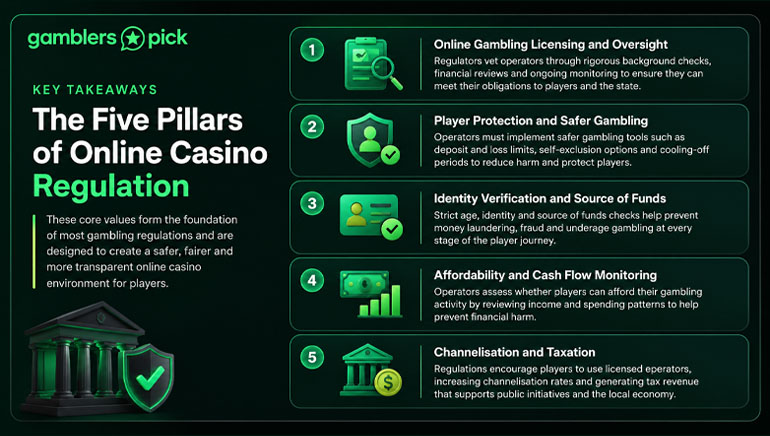
Before we can rightl judge whether this is all money-making malarky or actually holds value for players, here are the core values shared by most gambling acts.
To ensure that players can gamble with complete peace of mind, regulators put licensees through rigorous vetting and review processes.
These investigations review the financial and criminal histories of company stakeholders. They also determined whether the company has the funds or insurance policies to meet its financial obligations to players and the state.
To reduce gambling harm and protect players, operators are required to implement safer gambling protocols, including deposit and loss limits, as well as cooling-off periods. Where available, the casino must link to the national self-exclusion database.
To combat money laundering and negate the risk of underage gambling, the online casinos must have stringent age and identity verification processes.
These protocols apply to the sign-up phase, withdrawal requests, and continue in various ways throughout the player's time at the casino.
To combat financial harm and fraud, licensed operators are required to produce ‘proof of income’ and assess whether players are depositing at a level they can afford.
A major focus for all gambling jurisdictions is channelisation. This is the percentage of players who frequent licensed casinos rather than unlicensed operators.
Higher channelisation rates mean better protection for the local gambling community, while also ensuring revenue for the government, which helps fund support initiatives, grassroots community projects and generally uplifts the local economy.
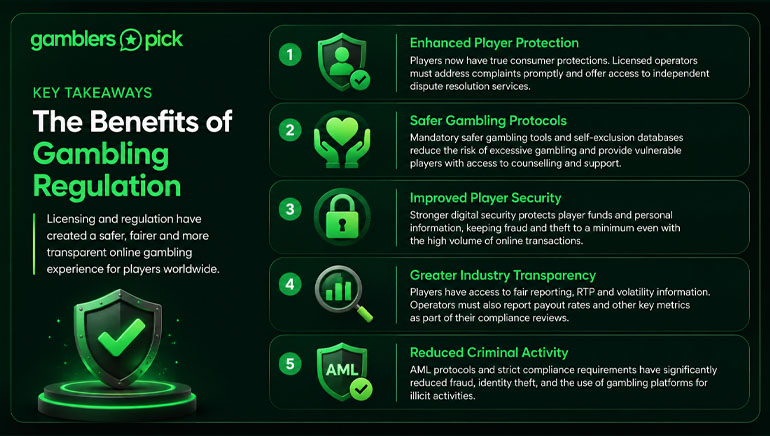
Here is how licensing and regulation have improved the online gambling experience for the majority of players worldwide.
Players now have true consumer protections due to gambling providers being required to address complaints promptly and the introduction of independent dispute arbitrators.
Mandating safer gambling tools and nationally managed self-exclusion databases have reduced the risk of excessive gambling and created space for vulnerable groups to receive necessary counselling and support.
Enhanced digital security protects player funds and personal information. These safety measures ensure that instances of fraud and theft are minimal despite the large volume and value of annual gambling transactions.
Players are aware of tools like provably fair reporting, and have a deeper understanding of the impact of return-to-player rates and game volatility. Operators are also required to report payout rates and other metrics as part of their compliance reviews.
Anti-money laundering (AML) protocols are an important aspect of licensing and compliance, which have dramatically reduced instances of fraudulent transactions on stolen cards, identity theft, and gambling sites being used to ‘clean’ dirty money.
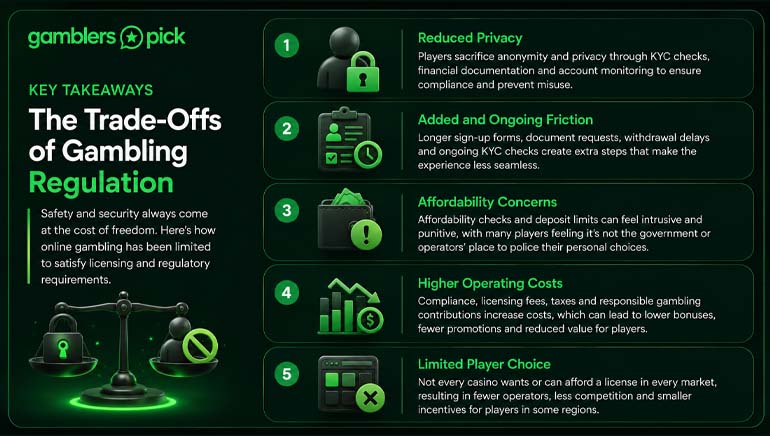
Safety and security always come at the cost of freedom. Here is how online gambling has been limited to satisfy licensing and regulatory requirements.
Online anonymity and privacy are sacrificed to ensure that casino accounts are not using stolen data. The requirements include providing financial documentation, proving the accuracy of personal account information, and other ‘Know Your Customer’ (KYC) checks and balances.
Rather than just jumping online and playing, licensed casinos introduce friction by enforcing longer registration forms, demanding detailed documentation before processing withdrawals, and running ongoing KYC checks.
Affordability checks and baseline deposit limits can feel punitive rather than protective. Many players also disagree that a company or the government has the right to invade their privacy, to police their enjoyment of a hobby.
Casinos are for-profit businesses; all the additional costs of compliance checks, licensing fees, revenue taxes, and responsible gambling “donations” will negatively impact player promotions and product offerings.
Not all popular online casinos will see the value in paying for a license in all regulated markets. This can leave players in smaller markets with access to a small selection of licensed operators, which in turn will offer smaller bonus offers to ensure profitability.
Having explored both sides of the debate, the conclusion isn't a one-size-fits-all answer; it comes down to personal choice.
The real question you need to ask yourself is:
“Do you value convenience, privacy and fewer restrictions, or are you happy to trade some of that freedom for stronger consumer protections?”
On the positive side, if you value local banking options, access to independent dispute resolution, and the reassurance that your chosen casino has undergone rigorous licensing and compliance checks, regulated operators will be the better fit.
On the other hand, if you place a higher value on privacy, are comfortable conducting your own due diligence, and appreciate greater choice and flexibility, offshore operators may be more appealing. This ensures you understand how deposits, withdrawals and player protections work before committing your time and money.
Understanding these trade-offs helps you choose both the top online casino and the jurisdiction that's right for you.
Drake is at the centre of a strange new entertainment controversy involving Highstack, an AI-powered casino concept, celebrity-themed games, and a disputed pitch deck.
Video slots have improved since the days of the three-reel slot games, with a greater number of paylines and ways to win, and superb features all designed to keep you playing. Knowing how these work can guide you to maximise your potential profits.
Kate Gavrilenko of Platipus Gaming explains how slot mathematical models are built, balancing RTP, volatility, probabilities, payouts and bonus features for successful games.

 Casinos
 Games
Games
 Jackpots