








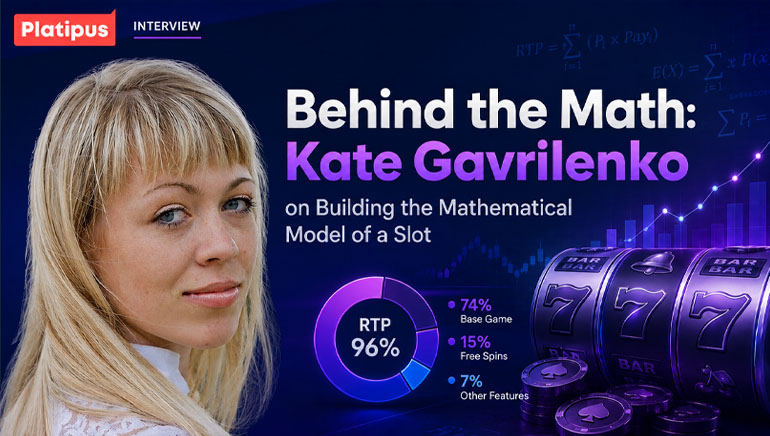
Kate Gavrilenko of Platipus Gaming explains how slot mathematical models are built, balancing RTP, volatility, probabilities, payouts and bonus features for successful games.
Players see reels, symbols, bonuses and multipliers. A mathematician sees something very different: probabilities, symbol weights, payout distributions, volatility, feature frequencies and millions of possible outcomes.
We spoke with Kate Gavrilenko, Mathematician at Platipus Gaming, about what actually happens behind the mathematics of a slot, how a game model is built from scratch, what defines volatility, how bonus mechanics are balanced, and why reaching the target RTP is only one part of creating a successful mathematical model.
Kate Gavrilenko: It starts with understanding what kind of game we want to create mathematically, not just what RTP we want to achieve.
When a concept comes to mathematics, we break it down into a system. What is the reel structure? How are wins formed? Which symbols are regular, premium, Wild or Scatter? What bonus features exist? Are there Cascades, multipliers, Free Spins or persistent mechanics? Most importantly, how should all of these elements interact?
From there, we define the mathematical profile we want to achieve: target RTP, volatility, hit frequency, feature frequency, average feature value, payout distribution and maximum exposure.
For example, if the concept includes Cascades with a progressive multiplier such as x1, x2, x3, x5, x10, we need to model much more than the maximum multiplier. We need to understand the probability of reaching every stage and how much each stage contributes to the overall RTP.
So mathematics doesn't come at the end of development to "calculate the RTP". It helps define how the game will behave from the beginning.

I would divide them into several connected layers.
First, we have the probability structure: reel strips or symbol weights, symbol frequencies, paylines or ways to win, Wild substitutions, Scatter combinations and other rules that determine how outcomes are generated.
Then comes the payout structure: symbol values, feature payouts, multipliers and the relationship between frequent small wins and rare large wins.
The third layer is the game's statistical profile. This includes return-to-player rates, volatility, hit frequency, bonus frequency, average win, average bonus value and the distribution of payouts across different ranges.
These layers cannot really be designed independently.
If I increase the probability of a high-paying symbol, for example, I may increase RTP, but I can also affect hit frequency and volatility. If I make a Wild more frequent, it can influence multiple combinations simultaneously. If that Wild also carries a multiplier, the effect becomes even larger.
This is why mathematical modelling is iterative. You change one parameter, analyse what happens to the rest of the system, then adjust again.
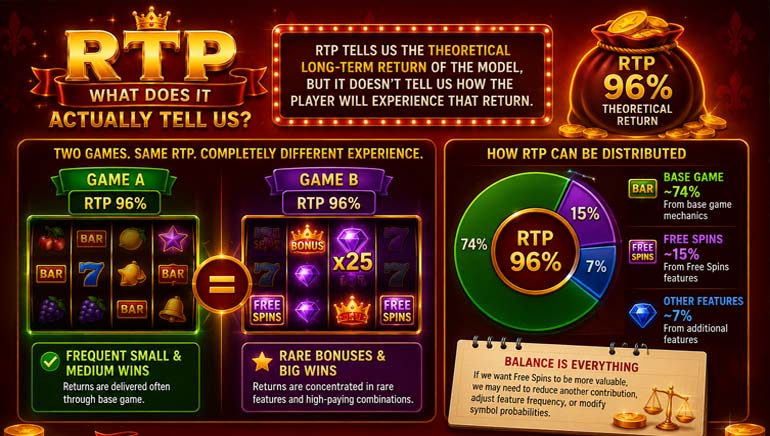
RTP tells us the theoretical long-term return of the model, but it doesn't tell us how the player will experience that return.
Imagine two games with 96% theoretical RTP.
One can distribute much of its return through frequent small and medium wins. Another can place significantly more mathematical value into rare bonuses, multipliers and high-paying combinations.
The final RTP can be identical, while the gameplay feels completely different.
We can also think about RTP as being distributed between different parts of the game. As a purely illustrative example, a 96% model might theoretically have around 74% coming from base-game mechanics, 15% from Free Spins and 7% from additional features.
If we decide that Free Spins should become more valuable, that balance changes. We may need to reduce another contribution, adjust feature frequency or modify symbol probabilities.
So for a mathematician, the question is not simply "Is RTP 96%?" It is also where that 96% comes from and how it is distributed across possible outcomes.
Volatility comes primarily from how probability and payout value are distributed.
Imagine two hypothetical casino games with the same 96% RTP.
Game A produces many outcomes between 0.5x and 5x, while very large wins are relatively rare.
Game B produces fewer meaningful small wins but allocates more mathematical value to outcomes such as 50x, 100x, 500x or 1,000x+.
Their theoretical return can be identical. Their variance is not.
This is why we analyse payout distribution in ranges rather than looking only at averages. We might examine how frequently outcomes fall below 1x, between 1x and 5x, 5x and 20x, 20x and 100x, 100x and 500x, and above 500x.
Hit frequency works the same way. A 25% hit frequency sounds informative, but if most of those hits are below the original bet, it creates a very different experience from a game with a lower hit frequency but a stronger average win.
The relationship between RTP, hit frequency, average win, and payout distribution is what really defines the mathematical character of the game.
This is where models become particularly interesting because features often depend on each other.
Take a Cascade mechanic with a multiplier progression:
x1 → x2 → x3 → x5 → x10 → x25
We need to know the probability of reaching every stage. Then imagine that during Free Spins the multiplier doesn't reset between rounds. Suddenly, the value of later Free Spins depends partly on what happened earlier in the feature.
That changes the entire probability structure.
Free Spins also have two important variables: frequency and value.
For example, purely hypothetically, one model might trigger a feature once every 150 rounds with a moderate average payout. Another might trigger once every 250 rounds but carry significantly higher average value.
If we change the trigger frequency from, say, 1 in 220 to 1 in 160, while keeping the same average bonus payout, the feature's RTP contribution increases. That means something else in the model usually needs to change.
This is why a request like "make the bonus more frequent" can result in changes to Scatter weights, multiplier probabilities, symbol distribution, base-game RTP and volatility.
A mechanic never exists mathematically in isolation.
We combine theoretical calculations with large-scale simulations.
Depending on the model and development stage, we can analyse millions or tens of millions of simulated rounds. This allows us to check whether simulated RTP converges toward the theoretical value, whether feature frequencies behave as expected and whether the payout distribution matches the intended volatility profile.
But we don't just look at the average.
We analyse how often bonuses trigger, how bonus payouts are distributed, how frequently different multiplier levels appear and what happens in the upper tail of the payout distribution.
Rare combinations are especially important. A video slot might behave perfectly across 99.9% of outcomes but contain one interaction between a Wild, multiplier and bonus mechanic that creates unintended exposure.
So simulation is essentially stress testing for the mathematical model.
If we change symbol weights, feature frequency or multiplier behaviour, we simulate again and compare the new distribution with the previous model.

For me, a strong model is not simply one that reaches the target RTP.
RTP has to be correct, but volatility should also match the intended profile. Hit frequency needs to make sense in combination with average win. Bonus frequency and bonus value need to be balanced. The payout distribution should have the right shape, and maximum exposure needs to remain within the intended parameters.
We also look carefully at the upper tail. If a game has a maximum win of, for example, 10,000x, I don't only want to know the probability of reaching 10,000x. I want to understand what happens before it: how frequently the model generates 100x+, 500x+, 1,000x+ and other high-value outcomes.
Most importantly, we need to understand the relationships inside the model. If we change one parameter, we should know which other metrics are likely to move and why.
That is the interesting part of slot mathematics. The player never sees symbol weights, probability tables or millions of simulated rounds. They see a Scatter land, a multiplier increase or a bonus trigger.
For the player, it is a moment. For the mathematician, it is the visible result of an entire probability system working underneath the game.
Armed with these handy insights into slot mechanics, mathematical models, and the real impact of RTP rates on your gaming, there has never been a better time to take Platipus Gaming’s slot collection for a spin.
Check out our recommended Platipus-powered online casinos, claim a generous welcome bonus, and enjoy some of the best casino entertainment the industry has to offer.
Looking for a fresh take on crash games? We explore engaging crash and tap games with entertaining themes inspired by pop culture and classic gaming.
Learn how crypto beginners can bet safely using stablecoins like USDT and USDC. Skip market volatility and explore 4 top-rated online casinos offering fast, reliable stablecoin deposits today.
Join us for a chat with Wiktoria Hanak of BF Games to understand how the provider decides which games to make and learn more about the mathematical model and bonus feature selection process.

 Casinos
 Games
Games
 Jackpots